Frequently asked questions about our German intensive courses
Clear answers about our method, lesson hours, A1–C1 levels, examination preparation and certificates, including specific figures and useful comparisons.
Frequently asked topics
Why is the course structured differently?
What is new about the teaching method?
The method combines five teaching days a week with active speaking, revision, shadowing and decoding, adapted to how the group learns. Learning methods explained →
Why are there so many teaching units?
A1 and A2 each comprise 120 units in total, B1 and B2 160 units each, and C1 240 units. This allows regular revision, speaking practice and retrieval of what has been learned. Why so many teaching units? →
Why is there no compulsory homework?
There is no mandatory homework. Important revision takes place during live lessons on five weekdays; additional practice material is available voluntarily without an extra fee. Read about our homework approach →
Why are A1–B2 evening classes 90 minutes long?
A1 to B2 evening groups have 90 minutes of live lessons each day, Monday to Friday. This balances intensive training with work and everyday commitments. Why 90 minutes? →
Why are there at most six learners?
Our small groups have 3–6 participants so everyone can speak regularly, receive immediate corrections and ask individual questions. Small groups versus large classes →
What German skills do you need at each level?
The .1 and .2 course structure divides the official A1, A2, B1, B2 and C1 language levels into manageable stages. They are not separate official CEFR levels.
What German do you need for A1?
A1 covers four skills: listening, reading, writing and speaking, developed in two courses totalling 120 teaching units. A1 begins with personal information and simple main clauses and progresses to short everyday situations, first connectors and simple messages.
This level builds listening, reading, writing and speaking skills progressively through its two course modules.
What do A1.1 and A1.2 cover?
They form two consecutive courses at the same CEFR level. The table compares their content.
| Area | A1.1 | A1.2 |
|---|---|---|
| Sentence structure | Very simple main clauses | Longer simple sentences with first connectors |
| Verbs | sein, haben and common present-tense forms | Modal verbs and separable verbs |
| Cases | Nominative | Basic nominative and accusative |
| Vocabulary | Personal details and simple daily life | Broader everyday vocabulary |
| Reading | Find details in very short texts | Read short connected texts |
| Listening | Recognise individual words and information | Understand short conversations and announcements |
| Writing | Short sentences and personal details | Write a short message or email |
| Speaking | Introduce yourself and answer simple questions | Handle basic everyday situations more independently |
What German do you need for A2?
A2 builds on the A1 basics in two courses of 60 units each. Learners develop the past tense, the accusative and dative, early subordinate clauses, connected everyday speech and useful written communication.
This level builds listening, reading, writing and speaking skills progressively through its two course modules.
What do A2.1 and A2.2 cover?
They form two consecutive courses at the same CEFR level. The table compares their content.
| Area | A2.1 | A2.2 |
|---|---|---|
| Sentence structure | Reliable main clauses and first subordinate clauses with weil and dass | Link several clause types using wenn, ob, deshalb and trotzdem |
| Past tense | Build and practise Perfekt | Confident Perfekt and important Präteritum forms |
| Cases | Accusative and dative in standard situations | Accusative and dative with pronouns, prepositions and verbs |
| Verbs | Modal and separable verbs | Reflexive, dative/accusative and prepositional verbs |
| Writing | Short message or email, 40–60 words | Connected email, complaint, invitation or enquiry, 60–100 words |
| Speaking | Describe everyday situations and answer simple questions | Give reasons, compare, suggest, respond and plan together |
| Reading/listening | Short clear everyday texts and situations | Longer everyday situations with multiple pieces of information |
| Course goal | Expand basic language | Connect ideas and prepare for examination tasks |
What German do you need for B1?
B1 consists of two courses of 80 units each: 160 in total. You practise more independent communication, connected sentences, opinions, past tenses, relative clauses and longer texts.
This level builds listening, reading, writing and speaking skills progressively through its two course modules.
What do B1.1 and B1.2 cover?
They form two consecutive courses at the same CEFR level. The table compares their content.
| Area | B1.1 | B1.2 |
|---|---|---|
| Sentence structure | Connect several simple main and subordinate clauses | Use longer complex sentences more reliably |
| Past tense | Perfekt and important Präteritum | Describe the past in greater detail |
| Subordinate clauses | weil, dass, wenn, ob, als | obwohl, während, bevor, nachdem, damit, falls |
| Relative clauses | Nominative and accusative | Nominative, accusative and dative |
| Passive voice | Practise the relevant language skills at this stage | Practise the relevant language skills at this stage |
| Declension/cases | Nominative, accusative, dative; articles, possessives, adjective endings | Consolidate declension, dative plural, basic genitive and case prepositions |
| Writing | Around 80–100 words | Around 100–150 words |
| Speaking | Give reasons and straightforward opinions | Argue, compare and respond |
| Reading/listening | Medium everyday texts, clear conversations and reports | Longer texts, conversations and interviews with several viewpoints |
What German do you need for B2?
B2 consists of two courses of 80 units each: 160 in total. You work with complex grammar, all four cases, more formal writing, nuanced arguments and more challenging listening and reading.
This level builds listening, reading, writing and speaking skills progressively through its two course modules.
What do B2.1 and B2.2 cover?
They form two consecutive courses at the same CEFR level. The table compares their content.
| Area | B2.1 | B2.2 |
|---|---|---|
| Sentence structure | Longer main and subordinate clauses with complex connectors | Maintain complex structures in longer texts |
| Declension/cases | Complete adjective declension, all four cases and longer noun phrases | Multiple modifiers, genitive phrases, nominalised adjectives and participial attributes |
| Relative clauses | Confident in several cases | Complex relative clauses including prepositions |
| Passive voice | Practise the relevant language skills at this stage | Practise the relevant language skills at this stage |
| Konjunktiv / indirekte Sprache | Practise the relevant language skills at this stage | Practise the relevant language skills at this stage |
| Stil und Nominalgruppen | Practise the relevant language skills at this stage | Practise the relevant language skills at this stage |
| Writing | Opinions or formal emails with pros, cons and counterarguments | Complex formal email or opinion with clear requests and structure |
| Besonderer Schwerpunkt | Practise the relevant language skills at this stage | Practise the relevant language skills at this stage |
Im Einstufungstest wird Deklination/Kasus bei B2 bewusst separat gewichtet: Satzbau 20 %, Zeiten 15 %, Deklination/Kasus 20 %, Wortschatz 15 %, Lesen/Hören 15 %, Schreiben/Sprechen 15 %.
What German do you need for C1?
C1 consists of two courses of 120 units each: 240 in total. The focus is on precision, advanced grammar, idiomatic vocabulary, complex texts, demanding discussions and exam readiness.
This level builds listening, reading, writing and speaking skills progressively through its two course modules.
What do C1.1 and C1.2 cover?
They form two consecutive courses at the same CEFR level. The table compares their content.
| Area | C1.1 | C1.2 |
|---|---|---|
| Grammar | Advanced with occasional uncertainty | Largely reliable and flexible |
| Declension/cases | Practise the relevant language skills at this stage | Practise the relevant language skills at this stage |
| Vocabulary | Broad and increasingly precise | Sophisticated, nuanced and appropriate for different registers |
| Reading | Complex texts, argument structure and some implied meanings | Nuances, stance, argument strategies and subtle distinctions |
| Listening | Long interviews/discussions at natural speed | Faster natural speech, indirect meaning, stance and intent |
| Writing | Structured argumentation, formal or neutral register | Nuanced, precise, stylistically and register-appropriate |
| Speaking | Argue fluently and respond to opposing views | Discuss complex subjects spontaneously and flexibly |
| Course goal | Practise the relevant language skills at this stage | Practise the relevant language skills at this stage |
What about telc, Goethe and certificates of participation?
Is telc or Goethe exam preparation included?
Yes. We integrate relevant exam types and tasks alongside practical language learning. You do not need a booked examination to join an intensive course. Exam preparation details →
Does Deutsch Intensivkurs conduct the official exam?
No. Official telc and Goethe examinations are conducted by authorised examination centres, which set exam dates and fees. Exam booking and fees are separate from the course. Read more →
Will I receive a certificate of participation?
After completing the course with at least 80% attendance, you receive a certificate of participation stating the level, period and lesson units. This is not the same as an official telc or Goethe exam certificate. Certificate of participation →
How do I find the right course?
Compare the curriculum for your current level, consider your schedule and ask about an appropriate entry point. You may register your interest without obligation; a place is confirmed only after payment. Help choosing your course →
Popular questions about B1 and C1 level, course length and tests
What is B1 German level and what can I do at B1?
B1 level means using German independently in familiar situations, including connected conversations about work and everyday life. Our complete B1 course covers 160 teaching units of 45 minutes.
How long does an online A2 German intensive course take?
Our complete A2 programme contains 120 units. At two units each weekday this is 12 teaching weeks, plus any breaks for public holidays or scheduled closures.
What does C1 German level mean?
At C1 level, learners can understand complex texts and use German fluently and flexibly in professional and academic situations. Our complete C1 intensive course covers 240 units.
Where can I take a free online German placement test?
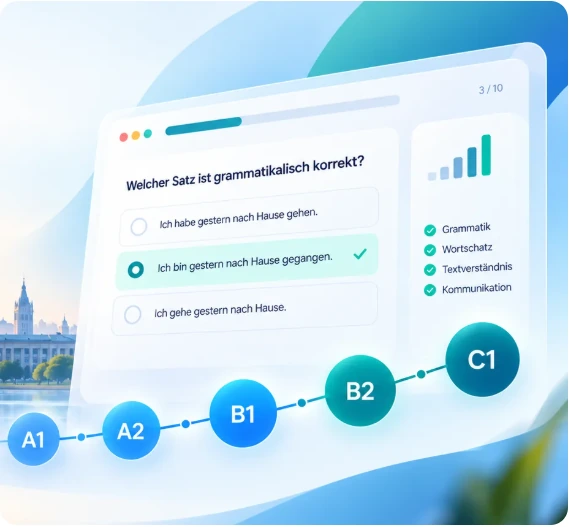
You can take our free German placement test to help identify a suitable level from A1 to C1.
Do you offer intensive telc and Goethe exam preparation?
Yes. Listening, reading, writing and speaking practice are integrated into the courses. Official exam fees and exam-centre bookings are separate.
Does my German teacher have to come from my state or region?
No. Standard German is used in all 16 German states and has recognised varieties in Germany, Austria and Switzerland. Your teacher’s region does not determine whether they can teach clear Standard German; our classes do not teach local dialects. Standard German versus dialect explained →